kyphoplasty, vertebroplasty (kyphon - kyph), Houston
Osteoporotic compression fractures of the spine
(thoracic and lumbar) can be very painful. Each year, 700,000 people
in the United States will suffer compression fractures of the spine due to
osteoporosis. Two
techniques which are available to improve pain from osteoporotic compression
fractures of the spine, and restore some of the height of the
vertebral body lost in a compression fracture. These techniques are
known as vertebroplasty and kyphoplasty (Kyphon - kyph). Both
techniques ( vertebroplasty and kyphoplasty) involve injecting cement into
the collapsed vertebral body in either the thoracic spine or the lumbar
spine, or both. With vertebroplasty the cement is
injected into the collapsed vertebral body, whereas with kyphoplasty (kyphon
- kyph), the vertebral body is first opened up or reduced, by the use
of a balloon on each side of the vertebral body. During kyphoplasty (kyphon
- kyph), the balloon and cement are introduced through the pedicle of the
vertebrtal body. During the kyphoplasty procedure, the cement is
introduced in a low pressure manner, since the cement is filling the void in
the bone which was created by the balloon. Using this low pressure
approach of kyphoplasty decreases the risk of forcing cement into the blood
stream, reducing risks of complications of cement migrating into the blood
and lungs.
Both techniques, vertebroplasty and kyphoplasty (kyphon
- kyph) have increased risk when there is siginficant retropulsion of bone
into the spinal canal. This is because, when the cement is introduced
during either technique (vertebroplasty and kyphoplasty (kyphon - kyph)), it
may leak back into the spinal canal, and impinge on the spinal cord or nerve
roots.
Both procedures (vertebroplasty and kyphoplasty (kyphon
- kyph) are performed under x ray guidance. This allows the spine
surgeon or neurosurgeon to make a small incision is made
in the back at the appropriate level, and the procedure is done under
fluoroscopy.
In cases where appropriate, both vertebroplasty and
kyphoplasty (kyphon - kyph) can be used at more than one level.
Technique of Kyphoplasty
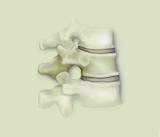 The
normal bones of the spine (thoracic or lumber) have a rectangular appearance, as is seen here.
On top of, and below the bone, are the intervertebral disc spaces. The
normal bones of the spine (thoracic or lumber) have a rectangular appearance, as is seen here.
On top of, and below the bone, are the intervertebral disc spaces.
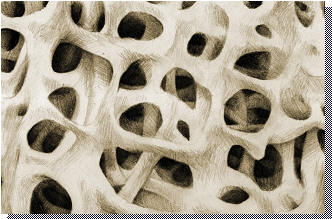
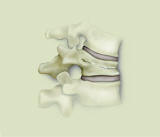 When
bone in the spine becomes weak, as happens in the case of aging, it may have
an increased risk of fracture. This fracture typically takes on the
appearance in which the end plates on the top and bottom of the vertebral
body come closer together. This is typically the appearance of an
osteoporotic compression fracture. A compression fracture may also
occur when there is tumor within the substance of the vertebral body, and
this is known as a pathologic fracture. When
bone in the spine becomes weak, as happens in the case of aging, it may have
an increased risk of fracture. This fracture typically takes on the
appearance in which the end plates on the top and bottom of the vertebral
body come closer together. This is typically the appearance of an
osteoporotic compression fracture. A compression fracture may also
occur when there is tumor within the substance of the vertebral body, and
this is known as a pathologic fracture.
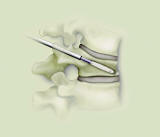
During the kyphoplasty procedure, an opening is made,
through the skin, into the pedicle, and subsequently into the vertebral
body of the spine. The hole is large enough to pass a small balloon.
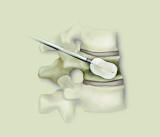 Once
the balloon is inserted, it is inflated, to expand the vertebral body, and
"reduce" the spinal osteoporotic compression fracture. Sometimes the
compression fracture can be improved in height substantially, and at other
times, only partially. Once
the balloon is inserted, it is inflated, to expand the vertebral body, and
"reduce" the spinal osteoporotic compression fracture. Sometimes the
compression fracture can be improved in height substantially, and at other
times, only partially.
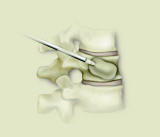
Once the cavity has been created in the osteoporotic
spinal
bone, the balloon is removed, leaving a hollow space.
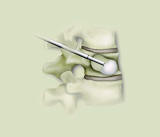
The cavity of the spinal osteoporotic compression fracture is
then filled, in a low pressure manner, with cement.
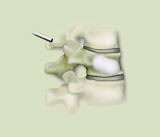 When
the cement hardens inside the spinal osteoporotic compression fracture, an internal
cast is created. This internal cast will provide additional substance
and support to the osteoporotic compression fracture, resulting in decreased
pain in most cases. Once the cement is hard, the patient can get up
and assume most of his/her activities. Of course, the adjacent bones
are still weak, and care must be taken to avoid injury to those levels. When
the cement hardens inside the spinal osteoporotic compression fracture, an internal
cast is created. This internal cast will provide additional substance
and support to the osteoporotic compression fracture, resulting in decreased
pain in most cases. Once the cement is hard, the patient can get up
and assume most of his/her activities. Of course, the adjacent bones
are still weak, and care must be taken to avoid injury to those levels.
Kyphoplasty is performed in Houston Texas at the Kraus
Back and Neck Institute. There are three offices in Houston Texas
which are conveniently located on the medical campuses of West Houston
Medical Center, and Memorial Hermann Memorial City Hospital, as well as in
Katy, Texas. The Kraus Back and Neck Institute serves patients in the
Houston area, surrounding areas in Texas, as well as other states in the
United States, and abroad. Three convenient locations are available in
Houston. Please contact us at 281-870-9292, to help
with your travel and hotel arrangements.
MORE ABOUT KYPHOPLASTY
|